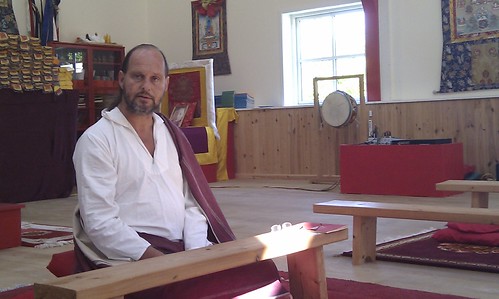
Joao and Peter serving.


RANGJUNG YESHE GOMDE SANGHA DENMARK


 Dear friends.


This summer at Gomde Denmark, the we have the unique opportunity to receive -- not only Padmasambhava’s wonderful terma treasure on Tara practice – but also the pointing-out instruction to the natural state of mind, the unity of stillness and insight, which is the nature of the mind all awakened ones. This indivisible unity of stillness and insight is known as samadhi. This samadhi is both the path and the fruition. I would like to quote Buddha Shakyamuni from a discourse recorded in the Samadhi Raja Sutra in which he describes the subtle connection between generosity and samadhi. Here word tathagata is a synonym for a buddha.
Once again the Transcendent Perfect Conqueror said to Youthful Moonlight: “Youthful one, this being so, a bodhisattva mahasattva who aspires to this samadhi and who wishes to quickly awaken truly and fully to unexcelled true and complete enlightenment should thoroughly train in this samadhi. Youthful one, how should he thoroughly train in samadhi for that purpose? Youthful one, such a bodhisattva mahasattva should, with a mind full of great compassion, in front of a living tathagata or to all those passed into nirvana, exert himself in making offerings of Dharma robes, alms, bedding, medicine, and other articles; of flowers, incense, scent, garlands, perfume, and fragrant powder; of garments, parasols, banners, and pennants of victory; of music from cymbals and bells; and then thoroughly dedicate the virtue of that to the attainment of samadhi.”
“He should not make offerings to the tathagatas while hoping for anything whatsoever, but should do so intent on the Dharma, without hoping for something desirable, without hoping for any enjoyment, without hoping for the higher realms, and without hoping for some samsaric state. Since, with such hoping, one doesn’t behold the tathagata as being the dharmakaya, how can one possibly behold him as the form-body (rupakaya)?”
“Youthful one, the way to make offerings to the tathagatas is without imagining the tathagatas, without conceiving of oneself, and without hoping for the karmic ripening. If you honor the tathagatas through this offering of threefold purity, you will fully attain this samadhi and awaken truly and fully to unexcelled true and complete enlightenment.”
Erik Pema Kunsang. From King of Samadhi, Rangjung Yeshe Publications.


The Essential Instruction on the Threefold Excellence contains three distinct views: Theravada, Mahayana and Vajrayana. The special approach it takes is to combine or interweave all three into a seamless single path that one person can follow. This small text begins in a simple way, with how to deal with life as a human being and goes all the way to how to attain true and complete enlightenment in a single lifetime.
The first level of the teachings here deals with being human. This means understanding that we have a precious opportunity right now in this life, and that it does matter how we behave: there are consequences to our actions. We are shown how to find the true spiritual path that leads us in the right direction.
The second level of teachings provides methods for reducing and dissolving our selfishness. It offers advice on how to genuinely work for others and gain mental stability and insight. In this teaching, insight is the core of Tara practice. Here it is called ‘the ultimate Tara of transcendent knowledge.’
Once we have stability and insight—often called shamatha and vipashyana—we as practitioners can then embrace Vajrayana, the third level, with skillful means that quickly dissolve habitual tendencies and delusions. Practitioners can awaken to buddhahood through sadhana practice based on Tara.
Padmasambhava explains that there are untold numbers of Tara tantras. The ultimate source of these infinite Tara tantras, practices and teachings is the female dharmakaya buddha Samantabhadri. Vajra Yogini, among whose countless emanations at the nirmanakaya level is Tara, spread them into limitless realms.
For our particular age, in recent times, all these tantras were condensed into three levels. The first, the extensive form, with an amazing number of teachings and rituals, was supposed to be revealed by the illustrious 19th-century master Jamyang Khyentse Wangpo. Unfortunately, due to a lack of auspicious coincidences, he never wrote down the instructions. He only retrieved the statue itself, which he recovered from a sacred location in the Zabbu valley of Shang in central Tibet and brought back to Kham.
The medium-length instruction, which Chokgyur Lingpa, a visionary master of the same period, revealed shortly afterwards, is called the Zabtik Drölma, The Profound Essence of Tara. It has several levels of practice: outer, inner and innermost. It is best known for its ritual of the four mandalas, which is widely practiced in hundreds of Dharma centers all over the world. Then there is the ultra-short instruction, which is the very core of this book. It is known as The Essential Instruction on the Threefold Excellence. It came about through the blessings of Samantabhadra, Vajra Yogini, Tara, and Padmasambhava with consort. When Chokgyur Lingpa saw Tara in a vision, she spoke three words: “Lekso, lekso, lekso,” which means “Excellent, excellent, excellent.” Based on this, the meaning of the instruction that is the very core of this book appeared in his mind as a profound Dharma treasure.[i]
Some time later, Jamyang Khyentse Wangpo gave the transmission for this revealed treasure to his close friend and disciple, Jamgön Kongtrül, a master who was foretold by the Buddha and whose writings are unparalleled in their conciseness and clarity.
In Skillful Grace we present the root text with two works of clarification—a pithy instruction by Tulku Urgyen Rinpoche, one of the greatest Dzogchen masters of recent times, and a longer, very practical guidance by Trulshik Adeu Rinpoche of Nangchen.
I feel we are incredibly fortunate that two recent masters who are holders of the lineage from Khyentse, Kongtrül and Chokling have given oral teachings on this text. It is with great joy that we share their wisdom with you, the reader. I wish that all of you receive the empowerment and instructions of Arya Tara and thereby receive her blessings, and that these blessings penetrate your lives and saturate everyone with whom you are connected.
Erik Pema Kunsang
Nagi Gompa Hermitage, 2006
[i] The Tibetan title is: dgongs gter sgrol ma’i zab tig las, legs so gsum gyi don khrid bzhugs
